
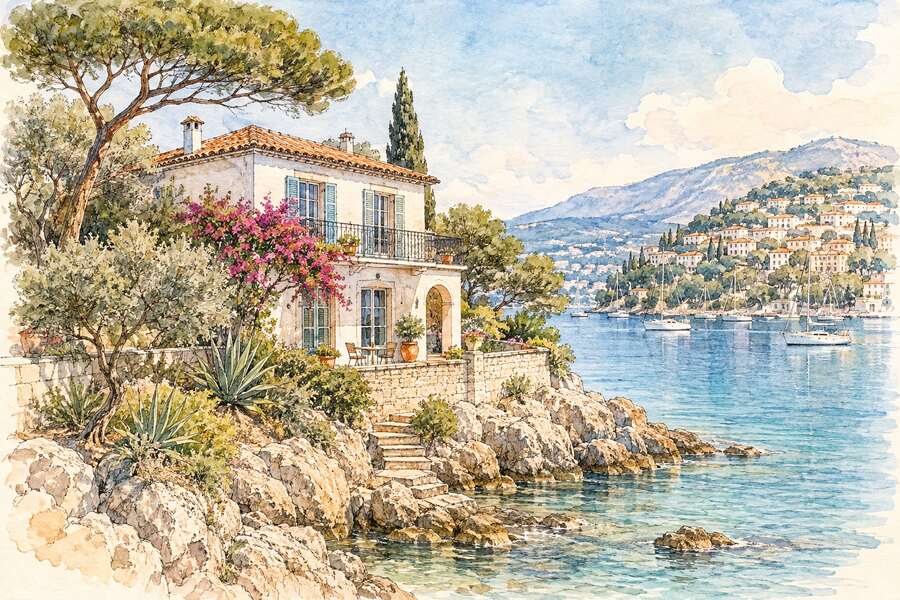
In short: Villa Santo Sospir is a seaside house on the western side of Cap Ferrat that Jean Cocteau covered in murals from 1950. He came as a guest of its owner, Francine Weisweiller, stayed on and kept returning until his death in 1963, calling it the “tattooed villa”. The house was listed as a historic monument in 1995, bought by the Melia family in 2016 and restored. It can be visited only by appointment.
Updated 19 November 2026 by Cap Ferrat Chronicle editors
Cap Ferrat is known for its palace hotel and its great Belle Époque gardens, such as the Villa Ephrussi de Rothschild. Villa Santo Sospir is something different: a modest family house that one of the twentieth century’s best-known artists turned into a work of art. It stands on the western shore of the peninsula, at 14 avenue Jean Cocteau, looking across the bay to Villefranche-sur-Mer.
This guide covers how Cocteau came to the villa, what he painted, how the house was saved and restored, and how to arrange a visit. For the wider story of the village, see our history of Saint-Jean-Cap-Ferrat.
What is Villa Santo Sospir?
France’s Ministry of Culture describes the villa as a house built between 1931 and 1935 in a Mediterranean regionalist style, on the western side of Cap Ferrat. It looks like many other Riviera villas from the outside: two storeys, pale walls, a tiled roof and a garden running down to the rocks. Inside, almost every wall, ceiling and door frame carries drawings and paintings by Jean Cocteau.
The ministry records that Cocteau decorated the villa from 1950 for its owner, Francine Weisweiller, and returned there until his death in 1963. The house was inscribed as a Monument historique on 5 May 1995, and in 2001 it received the label for remarkable twentieth-century heritage, now called Architecture contemporaine remarquable.
How did Jean Cocteau come to paint it?
Francine Weisweiller was a wealthy patron of the arts. According to the Financial Times, she and her husband Alec bought the villa in 1948. Cocteau met her in 1949 when she backed the film of his novel Les Enfants Terribles, in which her cousin acted, and in 1950 she invited him to stay at Santo Sospir for a short holiday. The local tourist board says the visit lasted far longer than planned.
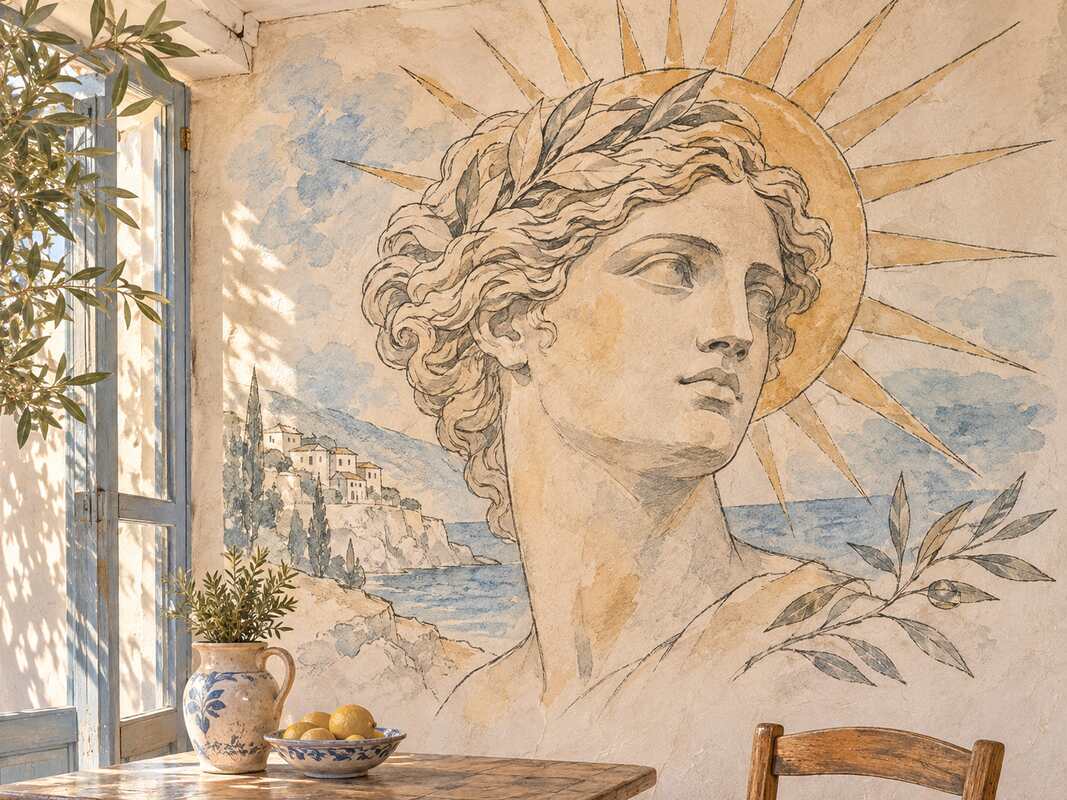
Bored by the white walls, Cocteau asked if he could draw a head of Apollo above the living-room fireplace. He did not stop. Over the following months he covered the walls of the main rooms with figures from Greek myth, faces, fishermen and the sea, and he later wrote that he had “tattooed” the villa, the phrase by which it is still known.
The frescoes and their themes
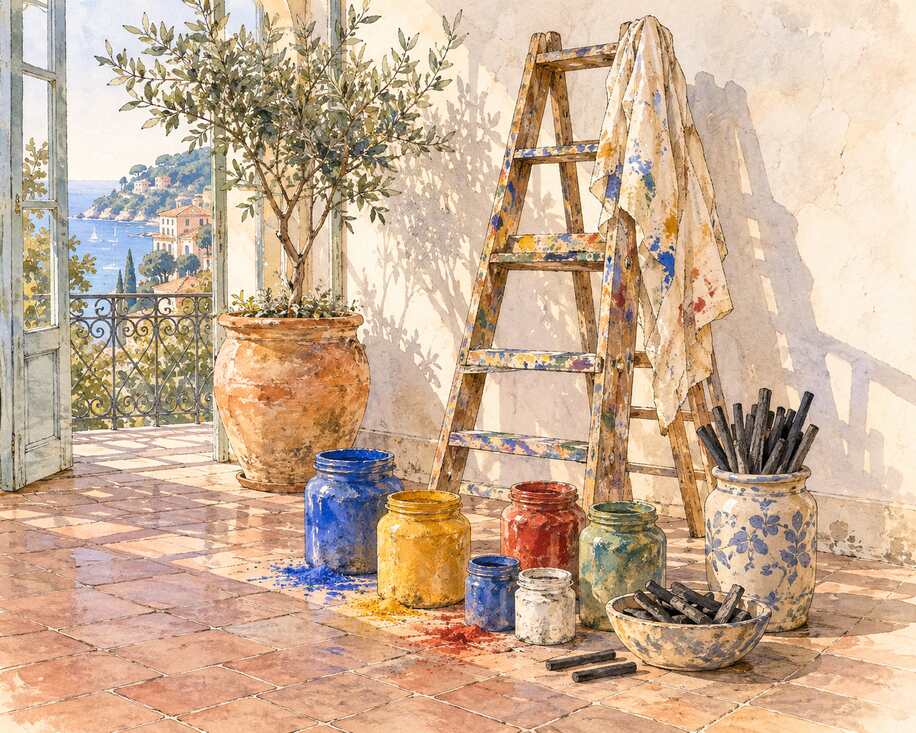
Cocteau did not paint true frescoes, which need wet plaster. Art Basel describes his method: he drew the outlines in charcoal directly on the walls, then added colour with powdered pigments mixed with raw milk, a technique that gives the colours a soft, chalky look. The ministry lists among the subjects Actaeon, the Bacchantes and Narcissus, along with Apollo and other figures from Greek myth.
- The living room. The Apollo head above the fireplace, the first work, sits among larger mythological scenes.
- The bedrooms. Smaller drawings and portraits, including figures linked to Cocteau’s own films and poems.
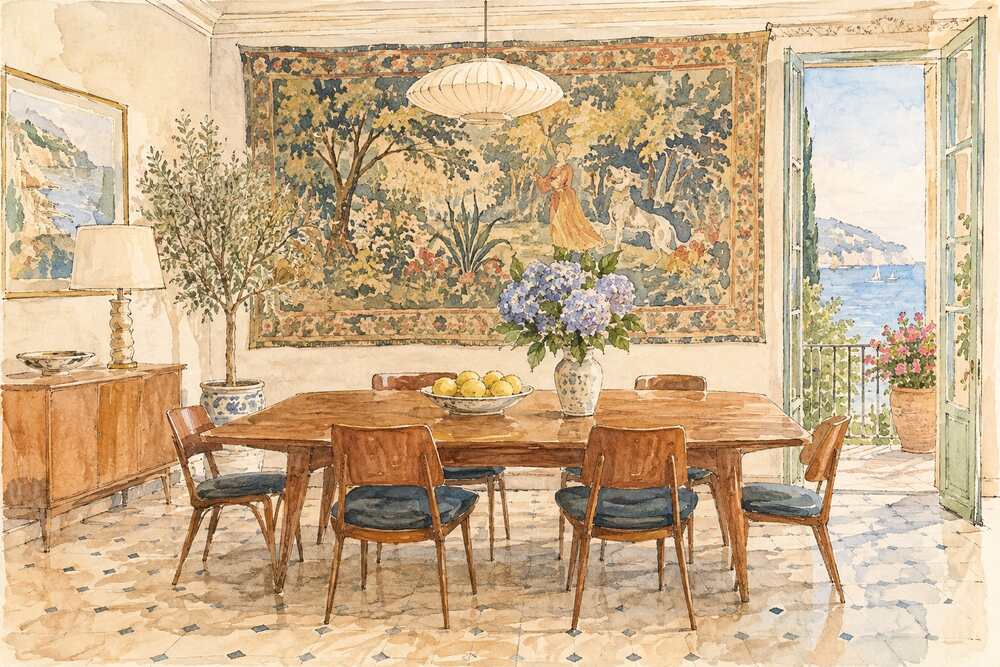
- Tapestry and furnishings. Cocteau also designed a tapestry for the house, and the interior designer Madeleine Castaing helped furnish it, according to Art Basel.
The villa became a meeting place for artists. Pablo Picasso, who lived nearby, visited, and Cocteau filmed parts of his last film, The Testament of Orpheus (1960), there. He also made a short film about the house itself, La Villa Santo Sospir, in 1952.
Cocteau’s other works around the bay
Santo Sospir was the start of a period in which Cocteau left his mark across the bay. He painted the Chapelle Saint-Pierre in Villefranche-sur-Mer, a fishermen’s chapel on the harbour, which opened in 1957. Further along the coast he decorated the wedding hall of Menton’s town hall, and Menton now has a museum devoted to him. A walk or short drive can link Santo Sospir with the Villefranche chapel on the same day.
Restoration and the villa today
Francine Weisweiller died in 2003, and the villa was looked after by her family for years afterwards, with the murals slowly fading. The Financial Times reports that the house was bought in 2016 by the Melia family, who restored it with the help of the decorator Jacques Grange and the garden designer Madison Cox, keeping the 1950s interiors and conserving the paintings.
The house remains private. Deutsche Welle and the local tourist board both note that visits are possible only by appointment, and are guided. Groups are small, so it is worth asking well in advance.
How to visit Villa Santo Sospir
- Book ahead. Visits are by appointment only and are usually guided; contact the villa through the Nice Côte d’Azur tourist board’s listing.
- Getting there. The villa is at 14 avenue Jean Cocteau, on the western side of the peninsula. Buses run from Nice to Saint-Jean-Cap-Ferrat, and the walk from the village takes about 20 minutes.
- Combine it. Pair the visit with the coastal path or the Villa Ephrussi gardens, or cross to Villefranche for the Cocteau chapel.
- Respect the house. The murals are fragile and the villa is a private home, so photography rules are set by the guide.
Key takeaways
- Villa Santo Sospir was built between 1931 and 1935 on the western side of Cap Ferrat and bought by Francine and Alec Weisweiller in 1948.
- Jean Cocteau began decorating it in 1950, drawing in charcoal and colouring with pigments in raw milk, and returned until his death in 1963.
- The villa was listed as a Monument historique on 5 May 1995 and given the twentieth-century heritage label in 2001.
- The Melia family bought it in 2016 and restored it; visits are by appointment only.
Common questions
Can you visit Villa Santo Sospir?
Yes, but only by appointment. The villa is a private house and visits are guided and limited to small groups, so book well ahead through the villa or the Nice Côte d’Azur tourist board.
Why is it called the tattooed villa?
Jean Cocteau covered almost every wall with drawings and paintings from 1950 onwards and said he had tattooed the house. The name has stuck.
Who owned Villa Santo Sospir?
Francine and Alec Weisweiller bought it in 1948, and Francine invited Cocteau to stay in 1950. Her family kept it until 2016, when it was bought by the Melia family.
What technique did Cocteau use for the murals?
He drew the outlines in charcoal directly on the walls and coloured them with powdered pigments mixed with raw milk, rather than painting true frescoes on wet plaster.
Is Villa Santo Sospir a historic monument?
Yes. It was inscribed as a Monument historique on 5 May 1995 and received the label for remarkable twentieth-century architecture in 2001.
How we put this together: the dates, protection and themes come from the French Ministry of Culture’s heritage record; the technique and furnishings from Art Basel; the ownership and restoration from the Financial Times; visiting details from the Nice Côte d’Azur tourist board and Deutsche Welle. We have not visited the villa for this guide, and opening arrangements can change, so check before you go.