
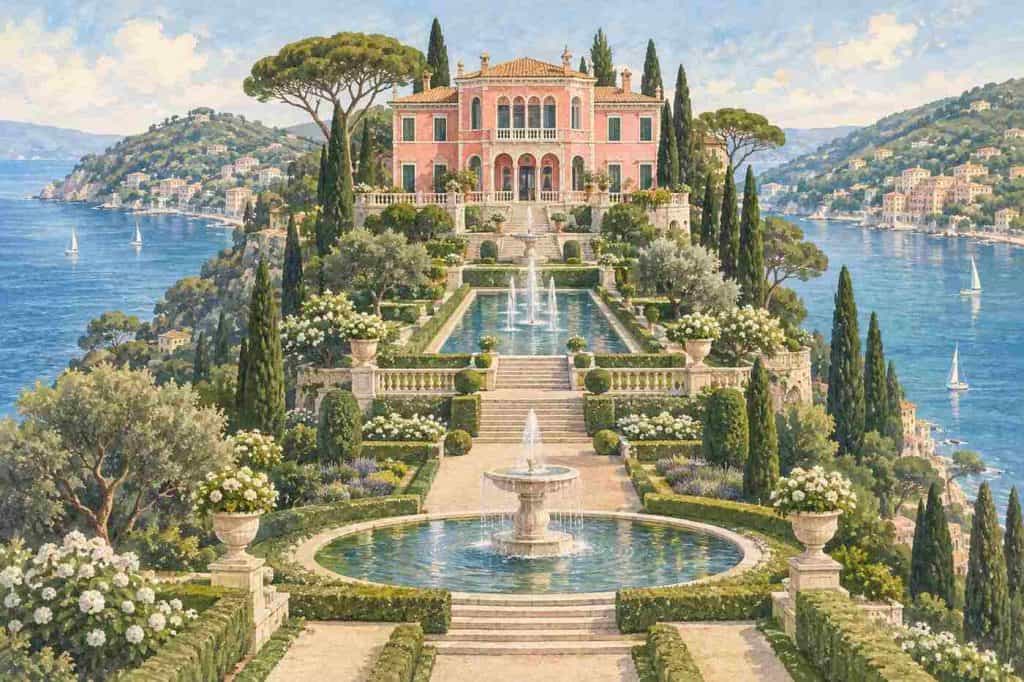
In short: The Villa Ephrussi de Rothschild is a pink Belle Époque villa on the narrowest part of the Cap Ferrat peninsula. Baroness Béatrice Ephrussi de Rothschild (1864–1934) bought seven hectares there in 1905 and built the villa and gardens between 1907 and 1912. She left it to the Académie des beaux-arts, and it opened to the public in 1937.
Of all the houses on Cap Ferrat, the Villa Ephrussi de Rothschild is the one visitors can actually walk into. Its pink facades, its long French garden and its views over two bays have made it the best-known sight on the peninsula. This guide covers who built it, why the sources disagree about its architect and its bequest, how the gardens grew and what remains today. It is part of an independent guide to Cap Ferrat; for the wider picture, see our history of Saint-Jean-Cap-Ferrat.
A few definitions. A bequest is a gift left in a will or deed that takes effect on, or before, the donor’s death. The Académie des beaux-arts is one of the five academies of the Institut de France, dedicated to the fine arts. A tempietto is a small round or columned garden temple, and a French formal garden is a symmetrical garden of clipped hedges, paths and water laid out on a central axis.
Who was Béatrice Ephrussi de Rothschild?
Béatrice was born in 1864, the daughter of Baron Alphonse de Rothschild, a banker and art collector. The villa’s official history says she married the Parisian banker Maurice Ephrussi at 19; he was 15 years older and a friend of her parents. The marriage went badly. Maurice was a gambler, and by 1904 his debts had passed 12 million gold francs. The Rothschild family took him to court, and the divorce was pronounced in June 1904, after 21 years of marriage.
Béatrice then turned to collecting. Her motto, Ars Patriae Decus, means art is the honour of the fatherland. Her father died in 1905, leaving her a large fortune, and that year she found the plot on Cap Ferrat. The official history says the site was a barren rocky ridge crossed by a mule track, and that she bought it quickly on learning that King Leopold II of Belgium was also interested in it.
Building the villa, 1907 to 1912
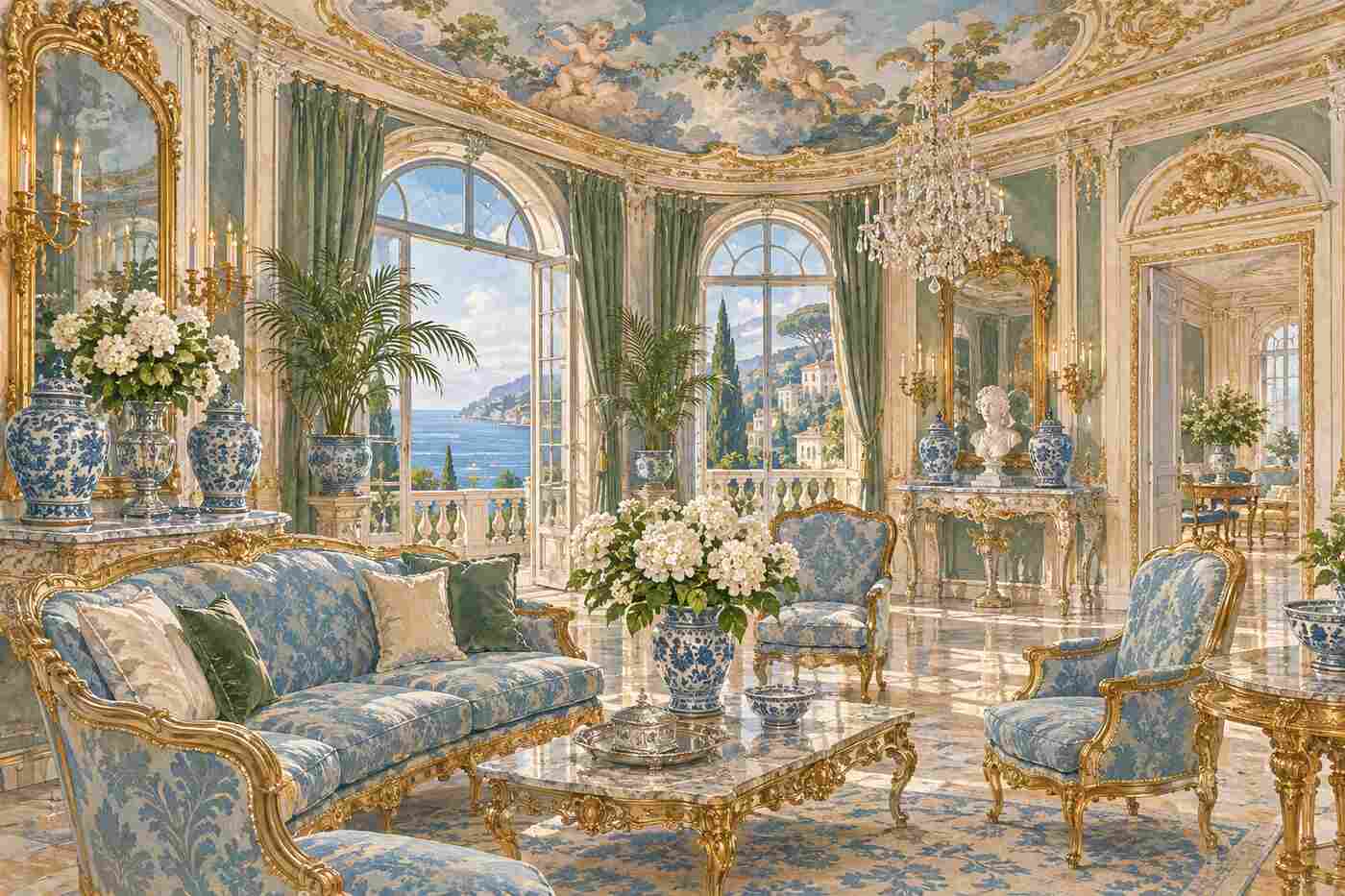
The Académie des beaux-arts, which owns the estate, says the villa and gardens took five years to build, from 1907 to 1912, on seven hectares on the narrowest part of the peninsula. The official villa site adds that work on the gardens began as early as 1905. The ridge had to be dynamited and levelled, with hundreds of Italian workers moving earth to make the ground usable.
Béatrice was a difficult client. According to the villa’s history, she rejected the plans of about a dozen leading architects, including Claude Girault, the architect of the Petit Palais, and Henri-Paul Nénot, who designed the new Sorbonne. She moved into the house in 1912 and used it as a winter residence for about ten years, alongside her homes in Paris, Monaco and Deauville. The villa was first named Villa Île-de-France.
Who was the architect?
The sources disagree. The villa’s official site says the design was entrusted to Jacques-Marcel Auburtin, assisted by Aaron Messiah, a Nice architect. Wikipedia and the Rothschild Archive name Aaron Messiah as the architect. The French art history database Agorha, run by the national institute of art history, attributes the work to Gaston Messiah working from Auburtin’s plans. The safest reading is that Auburtin drew the design and the Messiah family of Nice architects carried it out, but we cannot confirm the exact split.
The collections inside
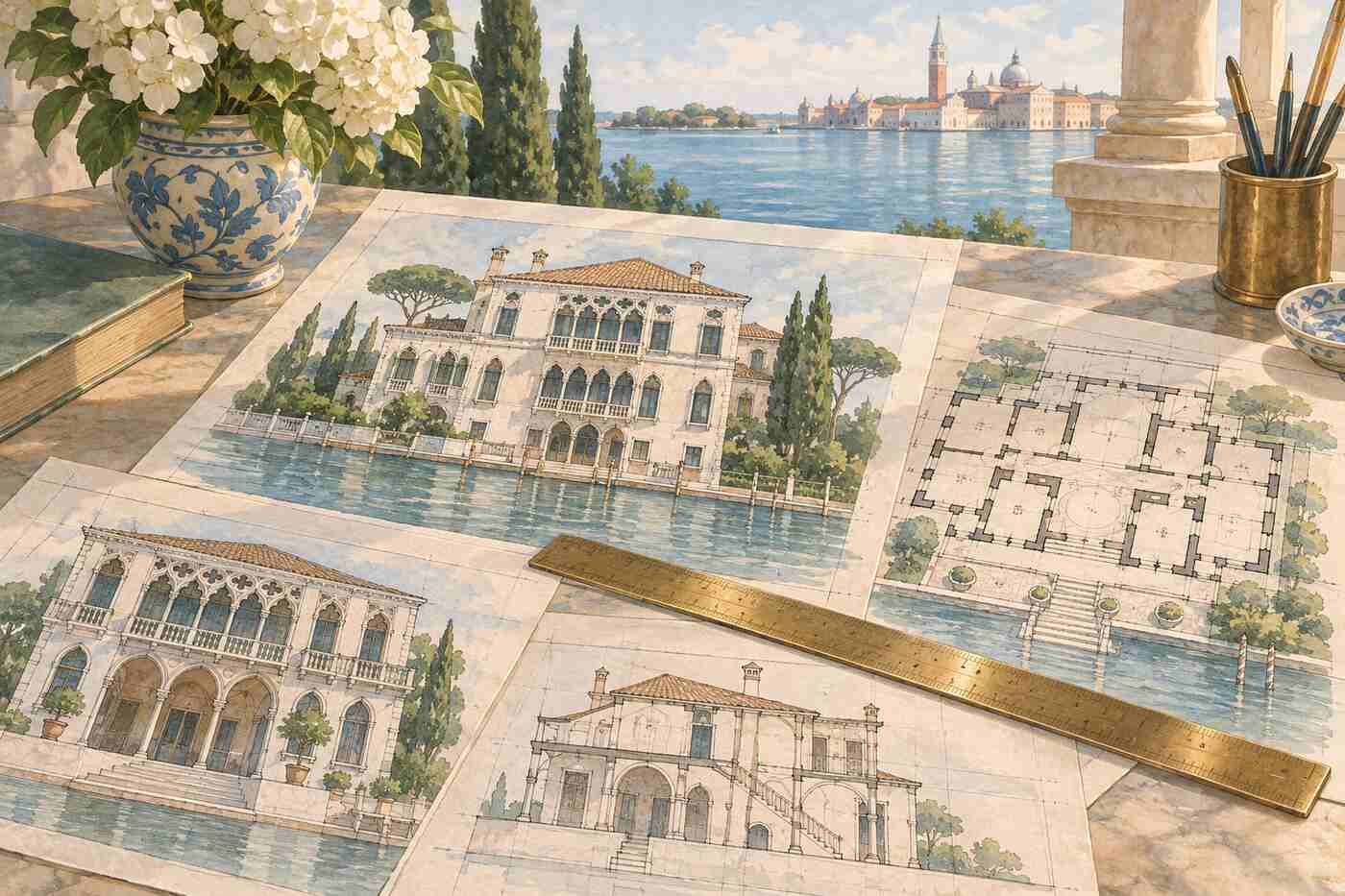
Béatrice filled the house with what the official history calls the Rothschild style: the best of each era, in an eclectic mix. Purchases named on the villa site include a Tiepolo ceiling, eighteenth-century furniture, a games table once owned by Marie Antoinette and a rug commissioned by Louis XIV. Trains from Paris brought furniture and art to the station at Beaulieu, where she chose pieces on the platform; anything she rejected went to her villa in Monaco.
The Académie says her bequest covered more than 5,000 works of art, drawn from her Paris house on avenue Foch, her two villas in Monte Carlo and the Cap Ferrat villa itself. Porcelain, furniture and paintings remain on display in the house.
Gardens shaped like a ship
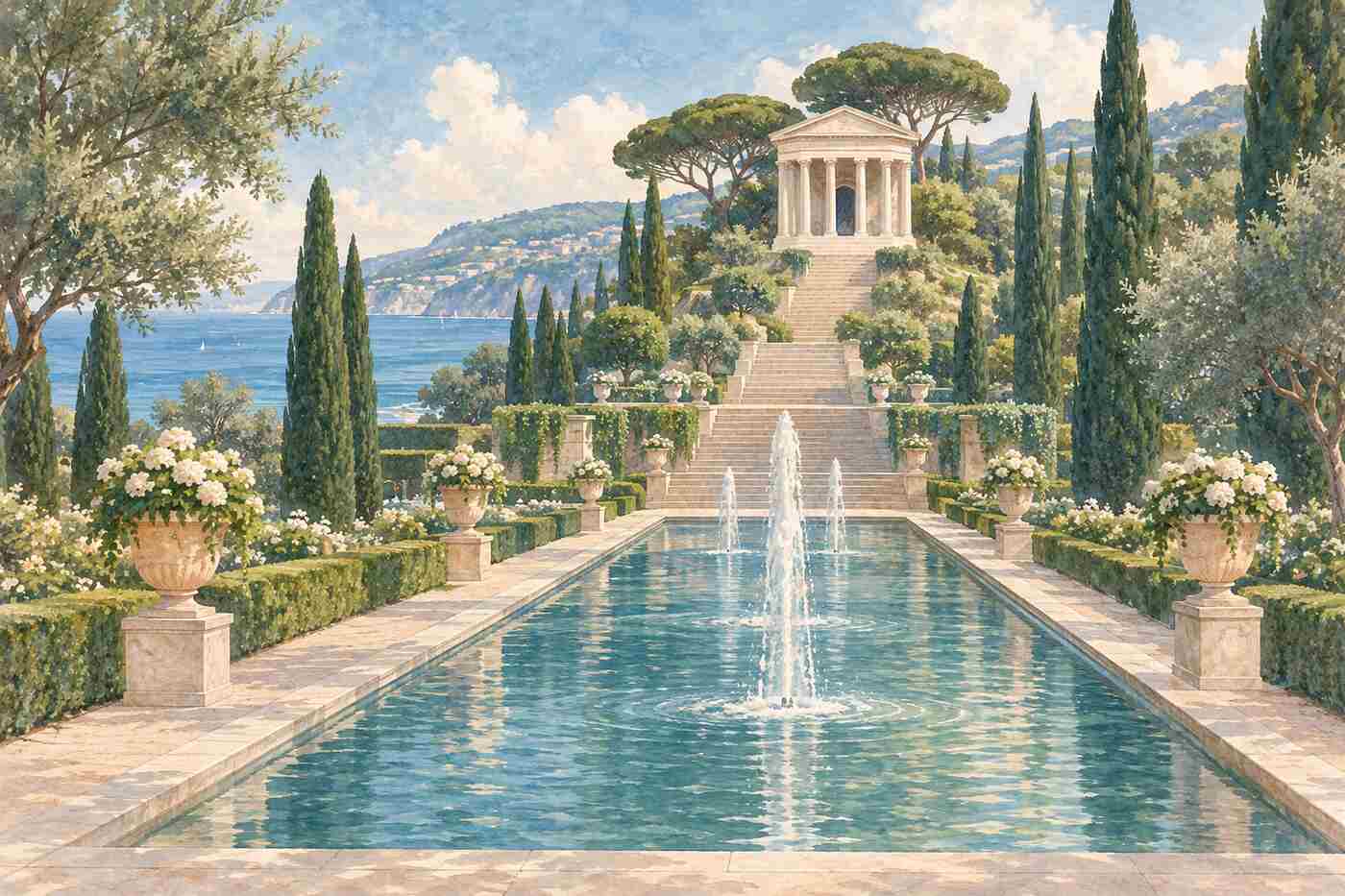
The gardens are the villa’s main attraction. The Académie says Béatrice conceived the garden as the bow of a ship, and placed mirrors near the tempietto at the top of the hill to reflect the sea and make the temple appear to float. The official history credits the landscape architects Harold Peto and Achille Duchêne with early work, and describes how staff hid inside green cardboard cypress shapes and moved long strips of fabric so she could judge where ponds and paths should go.
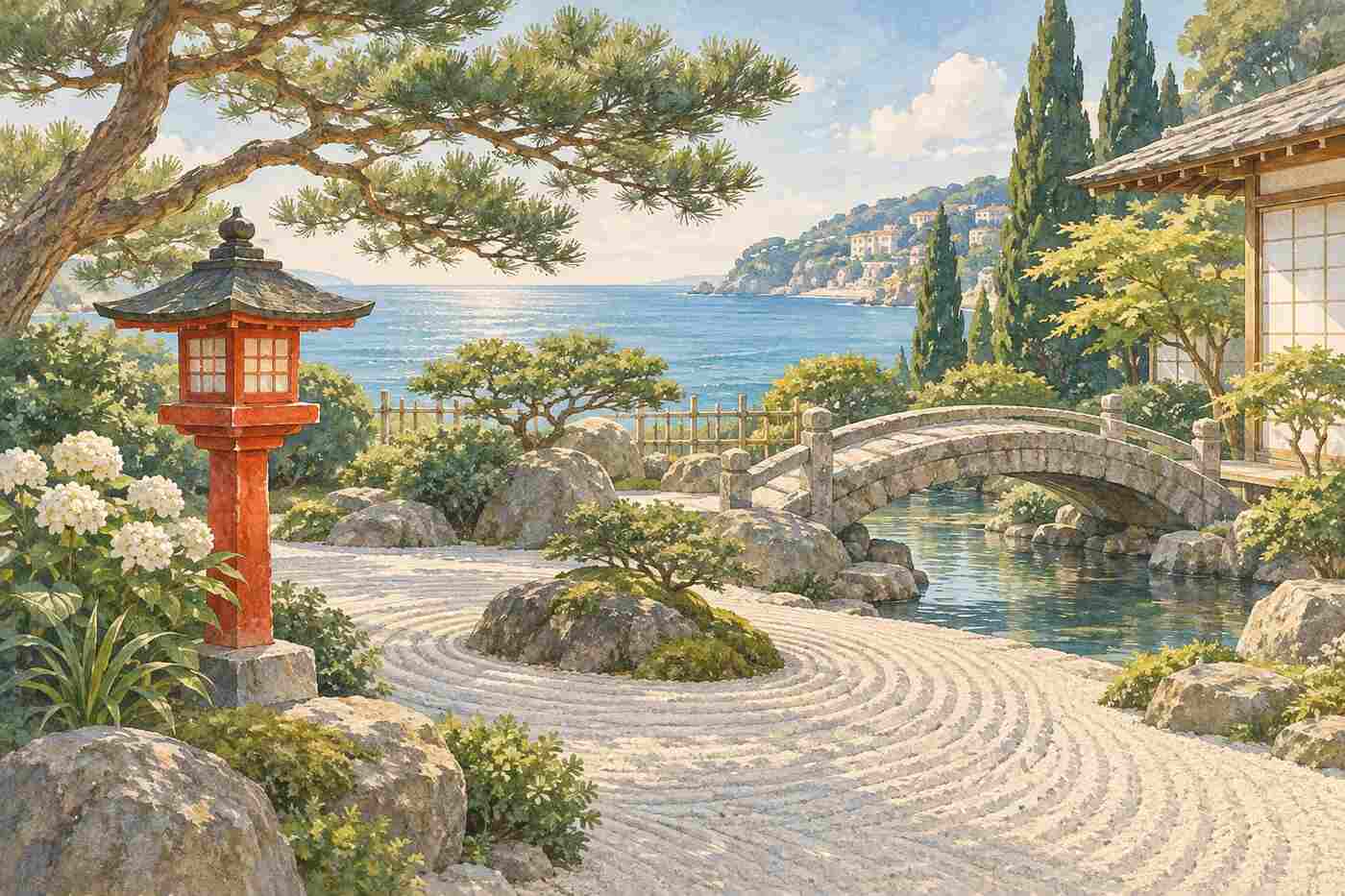
When she moved in, four hectares were still to be planted, and she gave priority to the French formal garden visible from the house. After her death in 1934 the landscape architect Louis Marchand designed themed gardens, including Spanish, Florentine, Japanese and Mexican ones. The number of gardens varies by source: the Académie counts seven themed gardens and a rose garden, while many guides, including Wikipedia, give nine gardens in total.
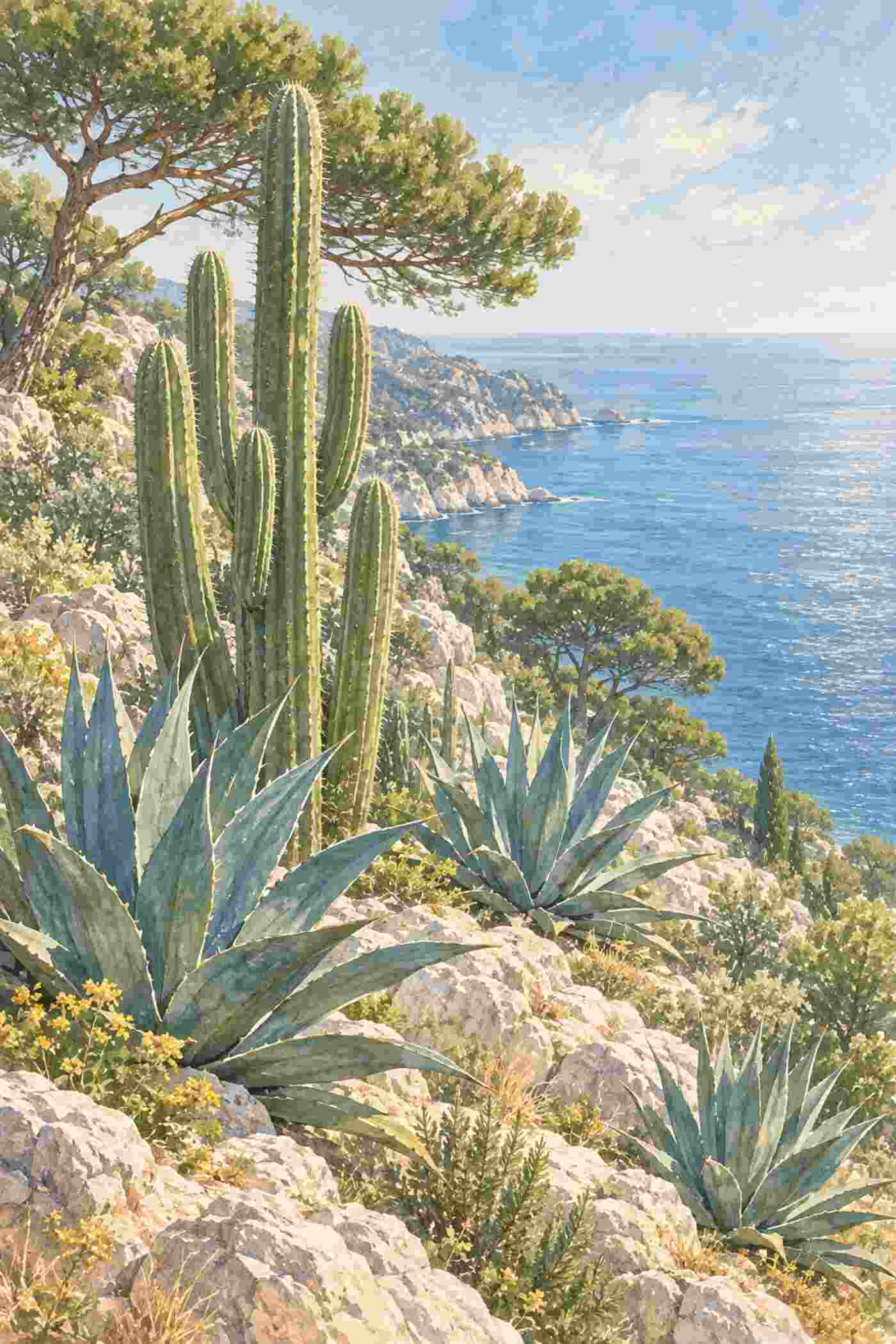
The gardens have suffered twice. During the Second World War the cape was emptied and mined and the gardens were abandoned for two years; Marchand restored them afterwards, and the facades were repainted from ochre yellow to the present reddish pink. A hard winter in 1985 killed many tall trees and almost all of the Mexican garden. The neighbouring Marnier-Lapostolle family, owners of the Jardin des Cèdres, gave plants from their collection to replant it, and it is now called the exotic garden.
The bequest and opening to the public
Here the sources disagree by a year. The official villa site dates the bequest to 1933, a year before Béatrice died of tuberculosis in Davos, Switzerland. The Académie des beaux-arts dates it to 1934 and says she made it in memory of her father, who had been a member of the Académie. Both agree the gift covered the house, its seven hectares and the collections, and the Académie says the villa opened to the public in 1937.
The villa and gardens have been listed as historic monuments since 1993. Since 1991 the Académie has entrusted the running of the site to Culturespaces, which restored the interiors and gardens to Marchand’s plan and organises events such as the rose and plant festival.
Timeline
| Year | Event |
|---|---|
| 1864 | Béatrice de Rothschild is born |
| 1904 | Divorce from Maurice Ephrussi |
| 1905 | Purchase of seven hectares on Cap Ferrat |
| 1907–1912 | Villa and gardens built |
| 1933 or 1934 | Bequest to the Académie des beaux-arts |
| 1937 | Opens to the public |
| 1991 | Culturespaces takes over management |
| 1993 | Listed as a historic monument |
Visiting the villa today
The villa stands at 1 avenue Ephrussi de Rothschild, at the neck of the peninsula, on the road from the village to the Grand-Hôtel du Cap-Ferrat. The official site gives winter hours of 10am to 4.30pm on weekdays and 10am to 6pm at weekends, and notes a closure on 14 December 2026; hours change in other seasons. It combines easily with a walk on the Cap Ferrat coastal path.
Key takeaways
- Béatrice Ephrussi de Rothschild bought seven hectares on Cap Ferrat in 1905 and built the villa and gardens from 1907 to 1912.
- The architect is disputed: Auburtin, Aaron Messiah or Gaston Messiah, depending on the source.
- The bequest to the Académie des beaux-arts is dated 1933 by the villa and 1934 by the Académie; the villa opened in 1937.
- The themed gardens were laid out by Louis Marchand after 1934 and replanted after war damage and the 1985 frost.
Common questions
Why is the Villa Ephrussi pink?
It was not always pink. The official history says the villa was ochre yellow until after the Second World War, when the building was renovated and repainted in reddish-pink tones that gave it a Venetian look. The colour has become its signature.
How many gardens does the Villa Ephrussi have?
The Académie des beaux-arts describes seven themed gardens and a rose garden, while Wikipedia and many guides count nine gardens. The difference depends on whether the French formal garden and the rose garden are counted with the themed ones.
Who owns the Villa Ephrussi de Rothschild?
The Académie des beaux-arts, part of the Institut de France, owns the villa, its gardens and its collections through Béatrice’s bequest. Since 1991 the site has been managed for the Académie by Culturespaces, which runs visits and events.
Did Béatrice live in the villa for long?
Not very. She moved in in 1912 and, according to the villa’s history, used it as a winter home for about ten years, dividing her time with Paris, Monaco and Deauville. She died in Davos in 1934.
How we put this together: Béatrice’s life, the building history, the gardens and visiting hours come from the villa’s official timeline; land area, the bequest, the number of works and the heritage listing come from the Académie des beaux-arts; the architect attributions come from the villa site, Wikipedia, the Rothschild Archive and Agorha. Where they conflict, we name each version.
Sources
- Villa et Jardins Ephrussi de Rothschild: The villa from yesterday to today
- Académie des beaux-arts: Villa et jardins Ephrussi de Rothschild
- Académie des beaux-arts: La villa et les jardins Ephrussi de Rothschild
- Wikipedia: Villa Ephrussi de Rothschild
- The Rothschild Archive: Rothschild gardens
- Agorha, INHA: Gaston Messiah, architect